
A Repeatable Network Troubleshooting Method That Saves Time
A practical workflow for isolating network faults without bouncing randomly between devices, tools and theories.
Practical references for troubleshooting, routing, switching, fiber, IP addressing and NOC operations. The focus is on what to check, what the evidence means, and how to verify the fix.
Three practical references for common faults that benefit from a structured approach.
A practical workflow for isolating network faults without bouncing randomly between devices, tools and theories.

Troubleshoot weak optical receive levels by working from measured loss instead of swapping parts at random.
A structured checklist for BGP neighbors that are Idle, Active or repeatedly resetting.
Search by topic or narrow the library to a specific engineering area.
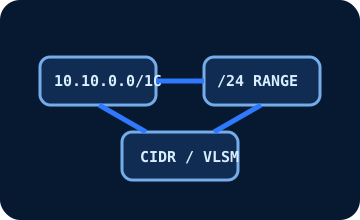
A practical guide to network addresses, masks, usable ranges, broadcast addresses and choosing the right IPv4 subnet size.
How CIDR blocks, longest-prefix match and route summaries work together, with practical checks for overlap and unintended reachability.
A practical way to allocate differently sized subnets, reduce waste and leave room for growth without painting the network into a corner.
How to read, compress, expand and plan IPv6 prefixes without getting lost in 128-bit notation.
A field-focused explanation of OSPF interface cost, reference bandwidth and safe path-engineering practices.
How to read AS_PATH, understand prepending and avoid assuming that the shortest path is always the selected route.
A practical guide to transmitter power, receiver sensitivity, fiber attenuation, connector loss, splice loss and engineering margin.
A clear explanation of absolute optical/RF power versus gain or loss, with quick reference examples for network engineers.
How availability percentages translate into minutes, what usually counts as downtime, and how to avoid misleading SLA reports.
How to use mean, median, volume and outliers together instead of reducing operational performance to one number.
A practical workflow for isolating network faults without bouncing randomly between devices, tools and theories.
A layer-by-layer checklist for troubleshooting physical and logical interfaces that will not come up.

Turn brief packet-loss complaints into measurable evidence and a smaller fault domain.
Separate propagation delay, congestion, routing changes and endpoint delay without guessing.
Interpret rising CRC and physical-layer counters without replacing hardware blindly.
Recognize MTU mismatches, oversized frames and path-MTU discovery failures.
Separate DNS failures from connectivity, application and routing problems quickly.
A structured checklist for BGP neighbors that are Idle, Active or repeatedly resetting.
Isolate unstable routes, interfaces and routing adjacencies before repeated changes impact the network.
Troubleshoot OSPF neighbors stuck in Down, Init, ExStart, Exchange or another incomplete state.
Recognize return-path differences and determine when asymmetry is harmless or the source of an outage.

A focused checklist for missing VLANs, native VLAN mismatches, tagging problems and trunk path failures.
Diagnose missing bundle members, suspended links, hashing surprises and inconsistent port-channel state.
A practical workflow for clients that cannot obtain an address or receive the wrong DHCP information.
Troubleshoot weak optical receive levels by working from measured loss instead of swapping parts at random.
Recognize connector contamination and avoid repeated optical faults during troubleshooting.
Check optics, compatibility, power and fiber before declaring a transceiver failed.
Plan a packet capture so you get useful evidence without drowning in unrelated traffic.
Recognize a Layer 2 loop, contain the blast radius, and restore service without creating a second outage.
Separate expected convergence from a real post-maintenance fault by using the change boundary and saved pre-checks.
No guides matched that search. Try a broader term or select All.