
Asymmetric Routing: When One Direction Tells a Different Story
Recognize return-path differences and determine when asymmetry is harmless or the source of an outage.
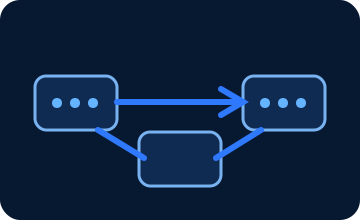
Asymmetry is not automatically a fault
BGP policy, ECMP, traffic engineering, and provider choices commonly produce different forward and return paths. The important question is whether a stateful device, policy, or capacity limit makes the difference harmful.
Firewalls, NAT, load balancers, and some monitoring designs may require consistent state for both directions even when routers are perfectly happy with asymmetry.
Collect evidence from both sides
Run traces from each endpoint or from representative devices near each side. Compare next hops, provider exits, VRFs, and policy boundaries. Packet captures on both sides of a stateful device can quickly show a flow entering one direction and returning somewhere else.
If you have only one side, use route tables and telemetry to infer the return path rather than assuming it mirrors the forward trace.
Look for the policy that changed one direction
A more-specific prefix, local-preference change, static route, PBR rule, default route, or redistribution event can alter only one direction. Compare current state with the known-good design and recent changes.
Fix the route or policy based on design intent. Do not force symmetry unless the application or security architecture actually requires it.